V2 · 12 servosDated experiment
Learning from real walking: trials, feedback and a live training loop
Ainekio now records ordinary walking, compares learned Walk and Run policies, and exposes learning history. Physical trials show modest tracking gains with important limits.
Published 5 min read
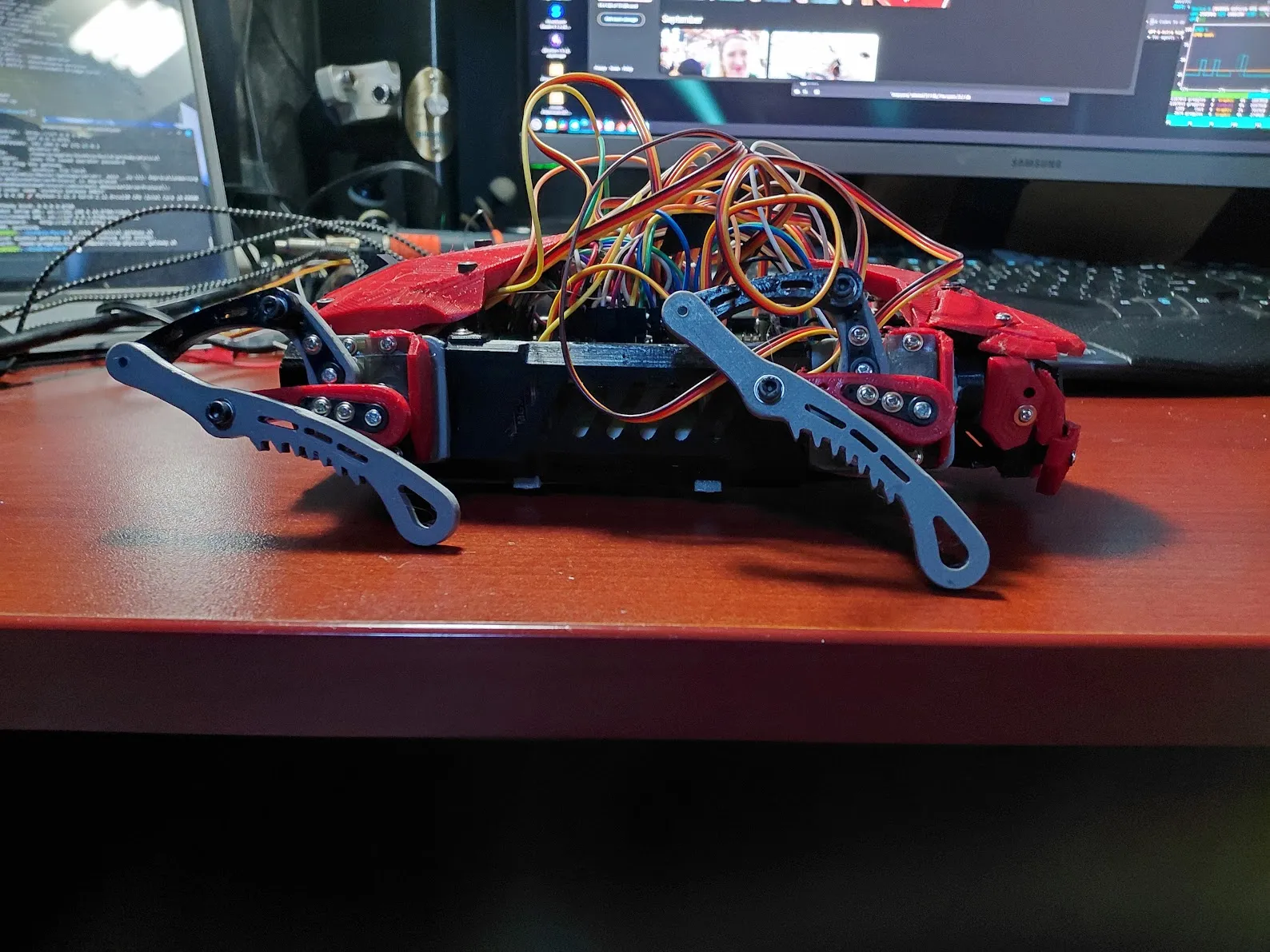
The previous update ended with twelve calibrated loose servos. Since then, the rebuilt robot has completed loaded walking comparisons, executed a learned correction on the P4, and begun collecting and comparing candidate gaits during ordinary Body Control use.
This is physical and software progress, with an important distinction: the learning loop works, but reliable walking is still the objective. On October 20 the owner reported that forward walking, backward walking, turning and Run remained unsatisfactory. Earlier favorable trials do not qualify every later revision.
What the first physical comparisons showed
October 19 trials recorded commanded motion, all twelve fourth-wire readings, IMU observations and camera frames. A host computer fitted a compact periodic correction; the P4 evaluated its coefficients alongside the existing gait. This is motor-policy fitting, separate from MetaHuman’s language-model LoRAs.
After short commissioning runs, a longer model was trained on its own recording and held fixed during four separate evaluation walks. Each evaluation included sixteen steady walking cycles. Gyro heading feedback stayed on and stationary self-leveling stayed off.
| Evaluation order | Learned correction | Estimated linkage tracking error | Owner-reported travel |
|---|---|---|---|
| Baseline 1 | Off | 17.26 mm RMS | About 18 inches |
| Candidate 1 | 50% | 16.72 mm RMS | About 21 inches; no dragging or sag reported |
| Baseline 2 | Off | 17.21 mm RMS | About 21.5 inches |
| Candidate 2 | 50% | 16.77 mm RMS | About 30.5 inches; no sag reported |
Pooled estimated tracking error fell from 17.23 to 16.75 mm, a 2.84% reduction for this forward-Walk comparison. The estimates come from measured shaft positions and linkage geometry; they do not measure foot contact, force or torque. Travel distances were owner observations against a tape reference.
Both learned runs had greater pitch excursion than both baselines. The second baseline also traveled farther than the first candidate. Two trials per setting are insufficient to establish a general travel, stability or energy benefit. The separate offline result explaining about 92% of a recurring error pattern is not a 92% walking improvement.
Learning during normal use
The next development moves recording and optimization into Body Control’s host service. Closing the browser no longer ends recording. The controls now include:
- Log gait data to retain observations without starting optimization.
- Learn while walking to compare policies using ordinary locomotion commands.
- Analyze now to calculate a proposal; with learning off, this does not install it.
- Progress by maneuver, exploration settings, and saved-policy restore.
The host uses Bayesian optimization through BoTorch. It can adjust gait profile parameters and the response to joint and body-motion measurements. The P4 still executes motion locally. Training does not dispatch walks, return the robot to a starting point, or pause ordinary movement while analysis runs.
The initial scope is forward Walk, backward Walk, both turning directions, and bounding Run. Walk and Run have separate policy storage and comparisons; Run retains its bounding gait. Crab and Crawl remain experimental and outside this initial optimizer.
What counts as a better candidate
The objective combines directional progress with yaw error, lateral drift, body motion and joint following. Comparisons match the commanded direction, stride and requested rate. Remaining still cannot win simply by eliminating vibration, and spinning beyond the requested turn earns no extra reward.
Before installation, the existing linkage preview checks the proposed change against the observed commands and saved calibration. That geometric check does not predict loaded stability, slipping or collisions. Candidates are installed in RAM; only an incumbent supported by the required comparison is saved to flash. Walk promotion needs repeated evidence across all four priority directions, rather than one successful forward run.
The October 20 live record completed a record → propose → install → compare → next-candidate iteration. The first Walk candidate did not demonstrate improvement, so the incumbent was retained and the service advanced to another candidate. Run accumulated a baseline and began its own comparison, which was still incomplete at the recorded checkpoint. No improved policy was promoted during that verification.
Camera progress is now connected, with uncertain scale
Body Control can select experimental MoGe-2 depth and landmark tracking as an alternative to its measured ground-plane method. The current implementation matches visual landmarks and estimates camera motion against retained 3-D points. This supersedes the first dense frame-to-frame depth comparison, which could mistake inconsistent learned depth for real motion.
The source feeds the existing locomotion-measurement and gait-recording paths. Its distances are labeled learned metric estimates: absolute accuracy and metric uncertainty are unverified. It is not calibrated visual-inertial odometry or a loop-closing map. A supplied camera-to-body transform accounts for mounting geometry; without one, the reported origin is the camera.
Blur, lost landmarks and transport gaps can make a window unusable. Tracking can start a new local reference, but no distance is invented across the gap. Valid measurements of a poor walk remain useful evidence against a candidate; missing measurements are not scored as zero error or zero travel.
A visible learning history
Recordings → Learning history now charts scored observations and candidate decisions. Filters separate gait, command conditions and measurement contexts. The table exposes individual measurements; expandable comparisons show policy changes and uncertainty. History can be downloaded as JSON without starting motion or analysis.
Activation checks recorded seven separate contexts, including a current Walk bank with sixteen scored observations and Run with three. Older records without timestamps remain explicitly undated. Changed measurement contexts are archived rather than mixed into a single apparent progress curve.
What remains to establish
The latest record still includes camera failures, HTTP peer closures and lost trace records. Completed scored windows survive later interruptions, but short unfinished windows may produce no observation. Logging and learning were left enabled for normal use, without more dedicated test sequences.
Repeatable forward/backward movement, turns and Run still need physical qualification. Metric camera accuracy, measured support/contact, energy use and autonomous return to a starting pose remain separate open work.
This report follows the October 19–20 gait journal, current host-learning and depth code, and Body Control documentation inspected October 21. The source snapshot records the local revisions, including unpublished working-tree changes. The header photograph shows the October 21 build; it is not a recording of the October 19 trials.
Learning from real walking: trials, feedback and a live training loop
https://ainek.io/posts/2026-10-21-learning-from-walking/