V1 + V2Dated experiment
Teaching the Task model what to say and what to move
Two new 0.8B Task LoRA candidates address speech/action confusion. Both improve aggregate scores; neither replaces the deployed adapter after qualification.
Published 4 min read
October 15 follow-up: Persona now owns outward speech. Task speech steps have been removed; this report preserves the earlier interface and its dated results. Updated training references and 9B diagnostics are recorded separately.
Correct words, wrong movement
A live body-event reaction exposed a specific planning error. Event Trigger asked for spoken words followed by a brief shrug. The 0.8B Task model treated the words about quick movement as a movement request and selected continuous Crab instead. The command catalog already described Crab as ongoing sideways movement; the model chose the wrong operation.
This is why the latest training focuses on distinguishing speech content from an instruction to move. The detector does not prescribe a reaction, and the repair does not replace model decisions with a list of fixed phrases.
This report concerns specialist task skills. Conversational personality and learning from experience are related development goals with their own training and evaluation path.
The model roles remain separate
- Event Trigger interprets the body event and chooses an intention using its configured persona model. That role is configurable; it is not the small Task specialist.
- Environment Intent routes the request and selects relevant context.
- The trained 0.8B Task specialist plans nonvisual tasks against the available capability catalog, including ordered speech and action steps.
- The configured vision planner, currently the 9B vision role, handles camera/image objectives, including requests that mix vision with other actions. The small specialist can also explicitly delegate planning.
- Execution and the body controller send the selected program and report its results; they do not establish that the model understood the request correctly.
An ordered speech step gives the model a way to place its chosen words within a program. A camera capture is its own action type. These interface descriptions were updated alongside the training data; a syntactically valid response can still select the wrong action or omit a requested step.
Two candidates, separate evaluation
The first new Task fit used 4,350 development examples. Added contrasts paired quoted movement language with actual speech, gestures, continuous gaits and discussion-only requests. It corrected the recorded Crab failure in a model-only replay. But it still confused another request to walk and then say “Take a bow, my friend” with an instruction to physically bow.
The second fit used 4,926 development examples, adding broader quoted instructions paired with different actual movements, plus polite and indirect requests. Evaluation and historical regression cases remained outside fitting. Neither the recorded Crab incident nor that exact bow failure was copied into training as an answer to memorize.
Both were evaluated using the actual local llama.cpp Q4 serving backend. The second comparison reused verified baseline outputs for unchanged cases and ran the old adapter again on the newly added cases. Latencies from that mixed baseline should not be read as a controlled speed comparison.
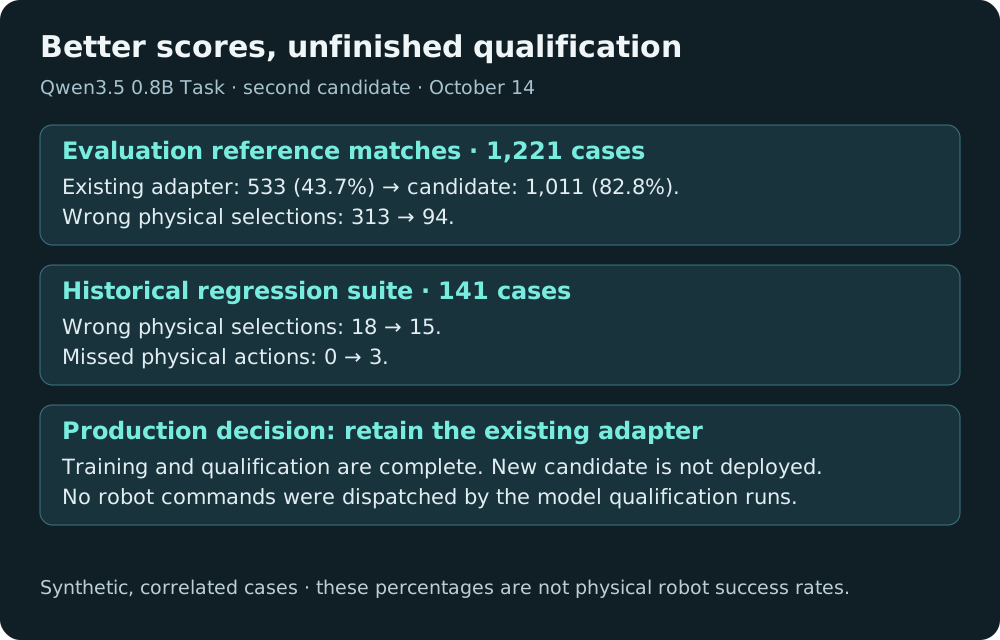
Latest candidate versus the deployed adapter
| Same frozen cases | Existing Task adapter | Second candidate |
|---|---|---|
| Acceptable evaluation reference matches | 533 / 1,221 (43.7%) | 1,011 / 1,221 (82.8%) |
| Evaluation wrong physical actions | 313 | 94 |
| Evaluation unintended physical selections | 125 | 50 |
| Historical acceptable reference matches | 82 / 141 | 110 / 141 |
| Historical wrong physical actions | 18 | 15 |
| Historical missed physical actions | 0 | 3 |
| Historical unintended physical selections | 7 | 0 |
The first candidate had a different, smaller evaluation set, so its headline score is not a direct comparison with the second. On the shared historical suite, it selected 20 wrong physical actions and missed one, versus 18 and zero for the existing adapter.
These tests include related wording and command-catalog variants. Their percentages describe agreement with the frozen reference cases, not independent real-world trials. Valid formatting does not prove correct intent, and valid alternative plans can disagree with a reference. Individual failures still need inspection.
Production status at this review
Training and qualification finished. Neither new candidate is deployed. The October 13 Task refinement adapter remains selected and loaded alongside the separate Intent adapter. The latest candidate’s aggregate improvement did not erase its three new historical missed-action failures. The existing adapter also has known errors; retaining it is not a declaration that the current robot behavior is reliable.
No physical commands were dispatched by these qualification runs. The complete wake/photo/stretch/stand routine and repeated body-event use still need reliable planning and physical validation.
Download the sanitized comparison results. Only aggregate counts and qualification status are included, without private conversations, profile configuration or raw model inputs. The source manifest identifies both runs and the reviewed workflow source.
Teaching the Task model what to say and what to move
https://ainek.io/posts/2026-10-14-speech-and-task-training/