V1 + V2Dated experiment
Training the Intent Orchestrator and Task Manager
Qwen 0.8B specialists, node-workflow changes, computer-task delegation and a side-by-side record of a rejected goal-planning candidate.
Published Updated 4 min read
October 14 follow-up
The October 14 Task training report records two completed speech/action candidates, the retained production adapter and visual-planner routing. Body Event Trigger adds a separate workflow for sensor events. The results below retain their October 12 observation period.
Smaller models with separate jobs
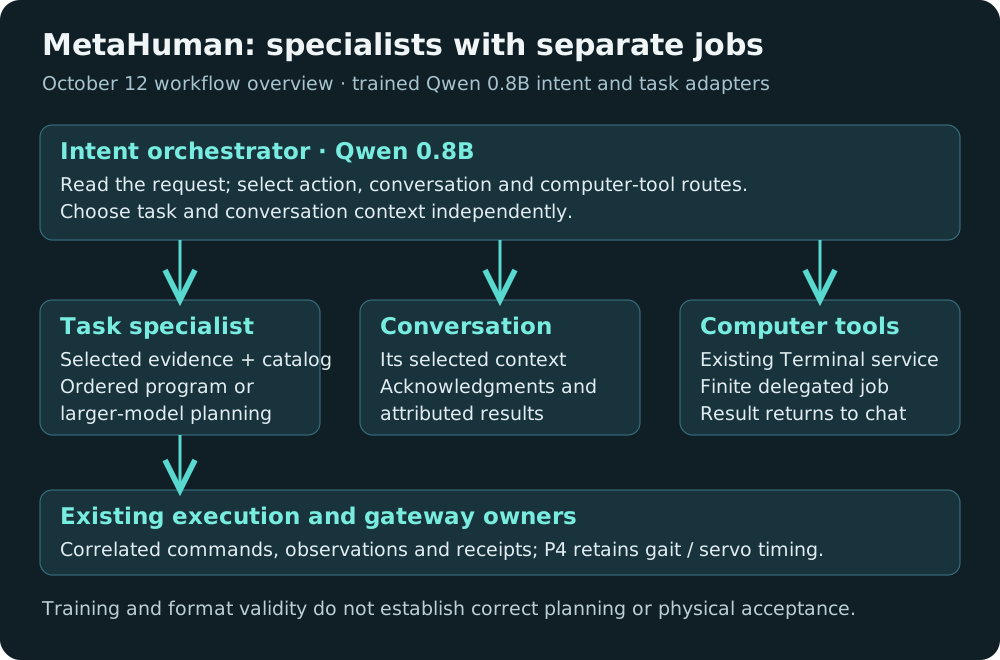
The intent orchestrator and task manager now have trained Qwen3.5 0.8B specialists. This extends the October 8 task/conversation split with actual training and activation records, extensive node-workflow changes, and explicit comparisons between model candidates.
Intent routing and task planning use separate adapters within the same execution workflow.
What each part does
| Part | Input and responsibility | Output / next owner |
|---|---|---|
| Intent orchestrator | Current request; selects whether to respond, act or use computer tools, and which context each consumer needs | Separate task/conversation context selections and routing decisions |
| Task manager | Selected evidence and the body’s advertised capability catalog | An ordered program, a task decision, or an explicit larger-model planning request |
| Conversation model | Its own selected context and attributed results | Spoken/written response; independent of task planning |
| Vision model | A specific image and its source identity | Image interpretation/acquisition evidence through the configurable Environment vision role |
| Existing execution and gateway | Admitted program, command results and observations | Body commands and correlated progress; the P4 retains servo/gait timing |
The intent and task models use independent LoRA adapters. Synthetic examples are generated with the runtime’s context builder and capability descriptions. Variants include reordered command catalogs, opaque identifiers, posture meanings, conditional requests, conversation-only requests and compound goals. Related variants stay together during training/evaluation splits.
From a training lane to recorded activations
The activation records show expanded intent and task 010 models loaded on
October 8 Pacific time (October 9 UTC). A later tool-routing intent adapter was
activated on October 9 Pacific time. The task assignment was retained during
that change.
On the expanded intent evaluation’s 200 synthetic requests, acceptable routing
increased from 60/200 to 185/200, comparing the earlier 009 adapter with
010 on the same snapshot. The measured median serving time was about
106 ms versus 100 ms on that desktop setup. The metric allows annotated response choices. The later
tool-routing corpus has a different snapshot and must be evaluated separately.
A smaller Speck2 experiment also ran: its recorded frozen-set acceptable routing was 173/200, versus 185/200 for the Qwen comparison. Qwen remains selected.
A better aggregate score was not enough
The later goal-planning candidate improved reference agreement on new evaluation cases, but regressed on previously inspected cases. The October 11 Pacific-time qualification decision rejected that candidate and retained the current task adapter.
| Same recorded test set | Retained task adapter | Rejected goal candidate |
|---|---|---|
| Evaluation reference matches | 159/234 (67.9%) | 184/234 (78.6%) |
| Regression reference matches | 93/138 (67.4%) | 90/138 (65.2%) |
| Unexpected physical selections relative to evaluation references | 21 | 12 |
| Unexpected physical selections relative to regression references | 15 | 20 |
| Evaluation median serving time | 489 ms | 484 ms |
| Output accepted by Core’s format/contract checks | 234/234 evaluation; 138/138 regression | 234/234 evaluation; 138/138 regression |
These cases contain correlated wording/catalog variants, so their counts are not independent real-world trials. Valid alternative plans can disagree with a reference. Conversely, an apparently valid program can drop the requested visual target or mistake a completed capture for completion of the whole goal.
The recorded review found unnecessary movement for conversational requests and both branches selected for mutually exclusive conditions. The original compound goal failure was not resolved by the candidate. The retained adapter also has unresolved failures.
The next local corpus adds paired contrasts: discussing versus executing a request, movement-only versus capture-only versus combined requests, and conditional alternatives versus unconditional sequences. Retraining and evaluation are next.
Download the sanitized comparison metrics. This contains aggregate results, without private runtime prompts or local model paths.
The node workflows are changing too
The committed computer-task route can ask the existing Terminal/Codex integration to do file, research or software work. Intent selects tool use independently of body action and conversation. The existing Work Coordinator admits that job; its attributed result returns to conversation without inventing another user turn. Available tools still depend on the configured installation.
Robot Status now reads current bridge, recognition, command and execution evidence when context is requested. It distinguishes fresh, stale, disabled, disconnected and failed recognition instead of presenting an old observation as current. The local vision continuation work returns acquisition evidence to the task workflow with its original request and retained image, allowing the task selector to choose what follows. Goal Review still assesses completion.
Further local changes refine cancellation/recovery, speech preferences, and the work-queue view. Active Operator remains untested on the robot.
Sources: committed live Robot Status work, computer-task delegation, and the local training, activation, qualification and workflow records identified in the source manifest.
Training the Intent Orchestrator and Task Manager
https://ainek.io/posts/2026-10-12-trained-specialists/