V2 · 12 servosDated experiment
A Face on the Robot: Display, Camera, and Voice Progress
The physical robot has an illuminated wide LCD. Explore actual renderer previews, recorded camera and speaker checks, and the expression and speech work still in development.
Published 3 min read
A working display, with a growing expression library
The October 8 photograph shows the physical robot’s wide LCD lit with its cyan resting face. The selected module is the recorded XIITIA 1.9-inch ST7789, using its 170 × 320 panel in 320 × 170 landscape orientation.
The local face library contains 59 selectable names, including resting expressions, speaking variants and faces associated with movements. Its previews come from the same C renderer used by the firmware. They are rendered pixels from the project, not concept artwork or photographs of the LCD.
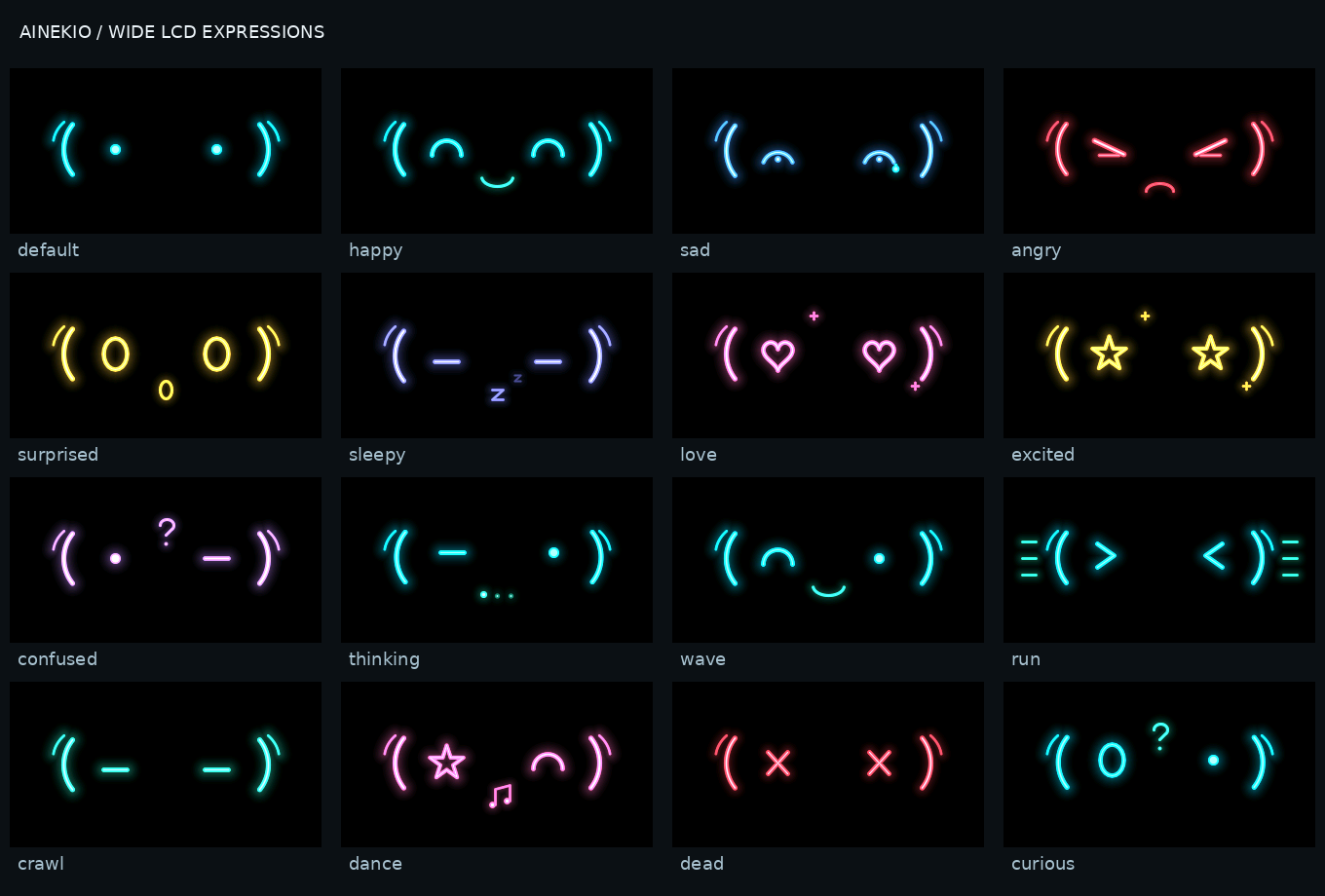
Recorded device results and current source work
| Area | Recorded result | What remains distinct |
|---|---|---|
| LCD and camera orientation | The October 6 firmware record says both were connected and working; LCD orientation was confirmed upright by the owner and fresh camera stills were upright | The photograph establishes a lit panel, not every expression or camera mode |
| Connected-screen presentation | The recorded 0.8.3 installation removes the connected text footer and adds small fault icons | Later workflow-driven expression selection is a newer source extension |
| Speaker output | The 0.8.4 installation record includes a completed low-volume tone; the owner reported that the connected speaker works | It is not a measurement of long-form speech quality or simultaneous media/motion load |
| Wake-word capture | The normal 0.8.6 image was reinstalled after transport and acoustic checks; live wake events and PCM were recorded without reported microphone drops | The owner reported needing close, loud speech; normal speaking-distance accuracy remains unqualified |
| Expression refinements | Local source adds revised animation, colored halos and workflow feedback through the existing renderer | These working-tree changes are separate from the recorded installed versions |
| Longer speech | Local MetaHuman source admits synthesized speech chunks while later chunks are still rendering | The robot’s sustained playback quality needs its own listening test |
The wake-word work fixed a specific recording problem: the gateway needed a recording-start event as well as the wake event to assemble the following audio. A later microphone-task stack increase addressed a live inference overflow. The recorded follow-up kept the controller connected through a 60-second check and reported 3,712 bytes of minimum free microphone stack. These are dated firmware observations, not a general claim that voice interaction is finished.
Expressions without requesting movement
Body Control’s Faces section selects an expression independently of motion.
Selecting a face named run or walk sends a face command; it does not start
that gait. Actual motion can select its associated presentation, and speaker
playback adds animated voice bars.
Open six animated previews from the renderer


The current local profile targets a deliberately stepped 15 fps animation style. The preview generator uses the firmware scheduler’s 66 ms frame interval. This is a configured target, not a measured CPU saving or display-throughput result. Thinking has a 7.2-second sequence; Listening uses a 2.4-second pulse. An animated thinking face by itself is not evidence that remote work is progressing.
The new workflow-feedback source gives each temporary expression its own selection identity. An old release message cannot clear a newer selection, and a configurable robot-local timeout returns to the underlying face. This extension requires updated P4 firmware and its matching MetaHuman path.
Reproducing the display work
The recorded panel uses SPI signals, despite its pins being labeled SCL and
SDA; they are not the servo controller’s I²C bus. The
project LCD guide
contains the module-specific pin table, wiring image and earlier implementation
record. faces.def owns the expression recipes, face.c draws them, and the
gallery tool invokes that renderer for its previews. Display work runs outside
the servo task.
The committed guide above predates some of the local refinements illustrated here. The October 8 manifest records the exact reviewed source and preview hashes. The P4 firmware record provides the dated installation and media-test details.
A Face on the Robot: Display, Camera, and Voice Progress
https://ainek.io/posts/2026-10-08-face-and-media/