V2 · 12 servosDated experiment
Steering, Sensing and Keeping the Robot Connected
Continuous steering, camera profiles, recognition interfaces and an IMU estimator have progressed. Live balance control and sustained wireless reliability still need work.
Published 4 min read
October 8: The lighter robot stands, walks, and responds to commands.
More responsive controls, with the feedback loop still to connect
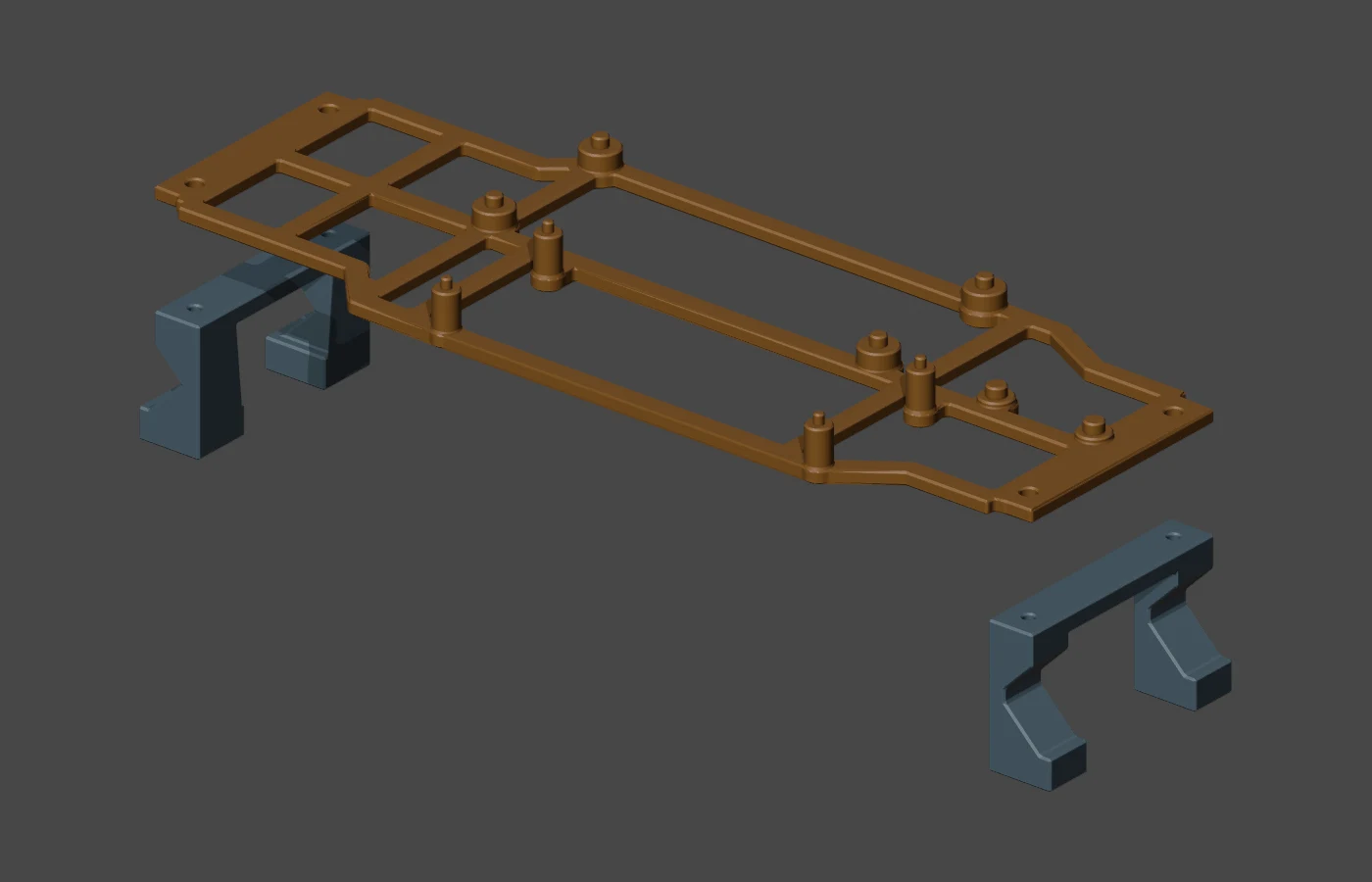
While the lighter chassis and revised legs are printing, the software has been moving forward too. Recent changes add continuous steering, more control over camera capture, recognition interfaces and clearer connection management. An IMU attitude estimator now exists in source.
This is progress toward responsive gait. The hardware acquisition task does not yet feed the estimator, and its output is not driving balance corrections. The printed chassis also could not stand in its previous configuration. Neither the software work nor the Blender motion previews replace that physical result.
Wireless is the current build priority
The two build options remain, with Wireless/offboard Q6A now the selected priority for reducing the weight and power demand carried by the robot.
| Responsibility | Wireless — current priority | Wired — retained alternative |
|---|---|---|
| Q6A computer | Offboard | Carried on the robot |
| Body connection | Wi-Fi | Planned native USB connection to the P4 |
| Local motion and servo output | P4 | P4 |
| Compute placement | Q6A gateway and selected higher-level work offboard | Q6A gateway and selected higher-level work onboard |
| Current qualification | Real hotspot association recorded; sustained connection remains unreliable | Native USB body transport remains integration work |
The P4 remains responsible for local motion execution and servo output. ROS 2, recognition and remote reasoning do not become independent owners of the legs.
Steering an ongoing walk
The gateway can update a running Walk action with paired forward and turn commands. Both use a signed −100 to +100 scale; positive turn is left yaw. The motion transitions through the gait cycle without starting a new action or resetting its phase.
The body and gateway negotiate steering support. A body without that capability rejects the new steering fields. An acknowledgement means that a setting was accepted; it does not mean the robot has reached a destination or completed a measured turn.
There are now separate controls for gait speed, stride/rate, named-motion speed and maximum joint speed. The common joint limit can slow the automatic motion clock while retaining its path. This makes the distinction between requested cadence and speed-limited output visible instead of implying that every requested rate is physically achievable.
The estimator is implemented; live balance is not
The portable C IMU module accepts timestamped six-axis samples, applies sensor-to-body alignment and calibration, and produces orientation plus freshness/startup/recovery status. It uses fixed state and has analytical host tests. Its code is compiled with the P4 build and host checks.
It contains no sensor driver, acquisition task or motor output. The current hardware task does not call it. Connecting the sensor, acquiring reliable samples and then using the estimates for motion correction remain separate steps. ROS 2 is not required to sit inside that fast local loop.
Desktop ROS 2 work has also advanced: the recorded Jazzy checks include matching talker/listener messages, an MCAP recording, a temporary workspace build and RViz startup. These verify the desktop tools. They do not establish an Ainekio ROS telemetry adapter or a running robot ROS graph.
Camera capture and recognition
The P4 camera code keeps one sensor/encoder owner while allowing independent preview and still-image profiles. Preview supports QVGA or VGA at 0–15 fps; still capture supports QVGA, VGA or XGA. A still can be requested with preview disabled. These profiles currently remain session settings rather than saved NVS configuration.
The gateway’s recognition worker processes one frame with at most one newest frame pending. Results from an old session are discarded. Configured local or HTTPS remote recognition can report a summary, objects and uncertainties through the existing environment bridge. The interface does not install a vision model or establish its accuracy, and recognition does not directly control gait.
A connection is useful only if it stays up
The Q6A hotspot work progressed beyond configuration: the P4 associated, obtained an address and completed authenticated settings readback. Servo power was disconnected for that networking test. The 120-second follow-up did not maintain the required 30-second continuous session; drops remain unresolved.
Portable pairing and gateway-selection support have been added in source, but the recorded installed firmware did not advertise gateway switching. Automatic switching between hosts therefore remains unproven on that device.
The latest remote development commit also adds the robot’s Wi-Fi network name beside connection status when the gateway can identify it. That improves diagnosis; seeing the feature in source does not establish that the running gateway has been updated.
| Area | Evidence available | Still to demonstrate |
|---|---|---|
| Continuous steering | Implementation and gateway/simulated-body checks | Loaded physical steering and turning behavior |
| IMU estimation | C implementation and recorded analytical tests | Sensor acquisition and balance feedback |
| ROS 2 | Desktop message, recording, build and visualization checks | Robot adapter and end-to-end telemetry |
| Camera / recognition | Capture profiles, worker and transport interfaces; software checks | Physical image quality, recognition accuracy and combined-load latency |
| Wireless connection | P4 association and authenticated settings readback | Sustained connection, recovery and device gateway switching |
Focused checks have passed in the development records, but broader recorded test runs still contain failures. This entry does not claim a fully green software suite or a completed hardware integration.
Record behind this entry
The baseline is robot commit 13fc3e4: the
gateway README,
body-control integration record,
IMU module
and ROS 2 setup record.
The later network-name status change
was reviewed from remote dev separately.
The source manifest records the reviewed files. Hardware observations here are from those dated records and my October 6 build report; no new device test was performed for this article.
Steering, Sensing and Keeping the Robot Connected
https://ainek.io/posts/2026-10-06-steering-sensing-connections/